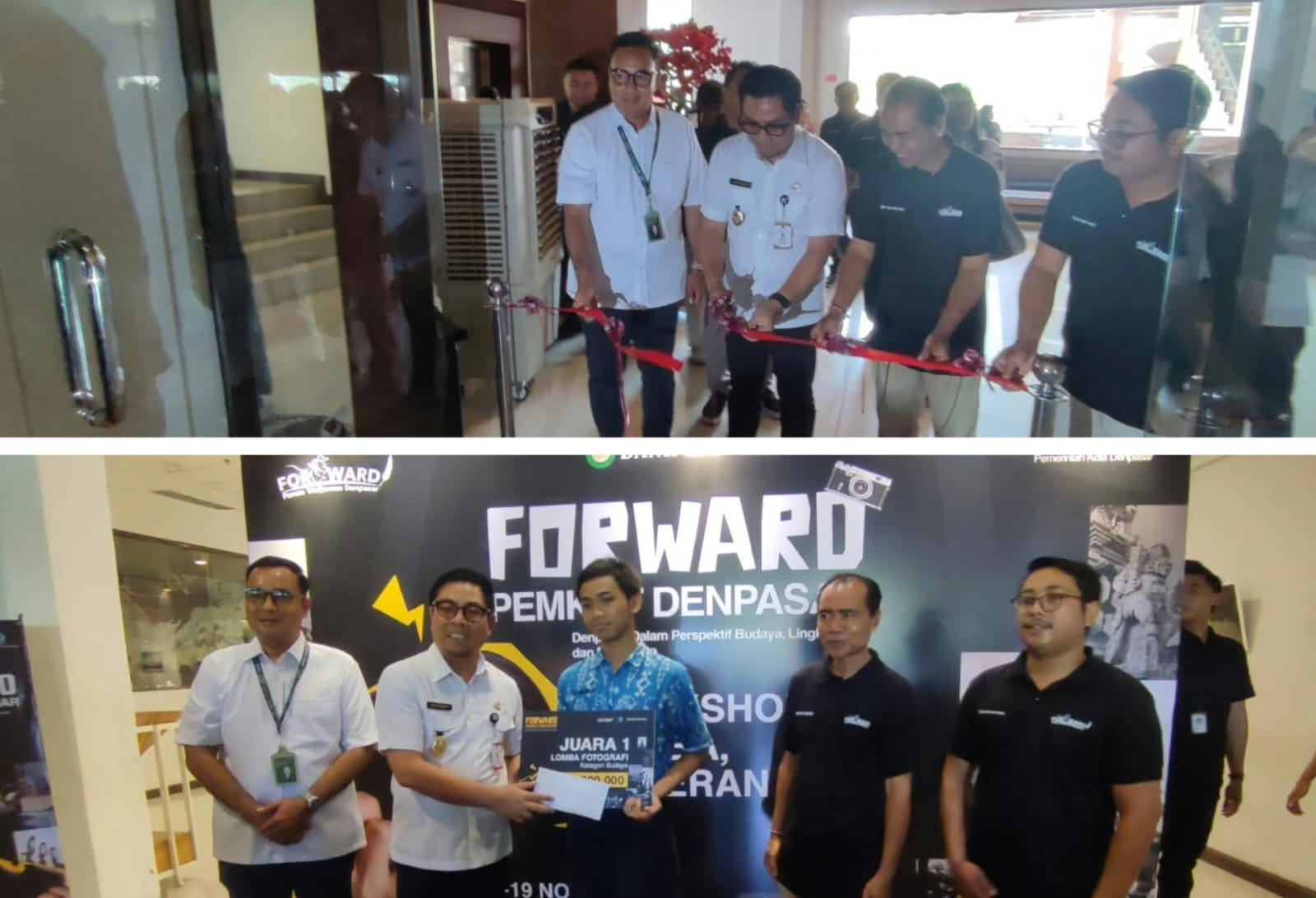
DENPASAR – Eighteen winning photographs by junior secondary school pupils went on display at Dharma Negara Alaya in Denpasar on Wednesday, 18 November 2026. The FORWARD exhibition brings young people's observations of culture, the environment and tourism into a public setting, offering a timely starting point for a wider question: what should a photograph help its audience understand?
Deputy Mayor I Kadek Agus Arya Wibawa opened the exhibition. FORWARD, the Forum Wartawan Denpasar journalists' forum, organised the programme with the city government. The competition followed a photography and journalism workshop held at the same venue on 11 November; judging took place on 15–16 November, with winners announced on 16 November.
Committee chair I Nyoman Miasa described photography as a means of recording events, communicating information and promoting regional potential. Those objectives make the exhibition more than a display of attractive compositions. They also invite a distinction between showing an appealing view and helping somebody understand the place behind it.
This article considers that educational opportunity. It is not a review of all eighteen winning pictures, nor an assessment of the judges' decisions. The practical exercises below are editorial suggestions for pupils, teachers and visitors, rather than activities confirmed as part of the organisers' programme.
From a striking image to a useful question
A photograph can attract attention through colour, light or a recognisable landmark. A useful next step is to ask what remains unclear after that first impression. Who is doing the work? What happened immediately before the shutter was pressed? Would the same location look different at another time of day? These questions turn looking into an active process instead of a quick verdict about whether a picture is beautiful.
For a classroom exercise, a pupil could choose a familiar street rather than search for the most spectacular destination. One frame might show the street as a whole, another a particular activity and a third a detail that explains how that activity works. The aim would not be to manufacture drama. It would be to discover whether a small sequence communicates something that a single wide view leaves unexplained.
The distinction matters for an audience unfamiliar with Denpasar. Local viewers may recognise a building or understand an everyday practice without explanation. An overseas reader may not. Good visual storytelling should not require that background knowledge: it should supply enough context without reducing the city to a collection of familiar tourism symbols.
Three themes, three different reporting tasks
Culture, environment and tourism can overlap, but each theme asks the photographer to pay attention to different evidence. In a cultural story, an object or performance may be only the visible endpoint of preparation, learning and maintenance. An educational assignment could therefore ask pupils to explain the relationship between the activity and the people who sustain it, rather than treating costume or decoration as the complete story.
An environmental photograph requires particular restraint. A picture of litter records what was visible in one place at one moment. By itself, it does not establish the cause, the duration of the problem or whether conditions elsewhere are similar. A stronger follow-up would record the location and time, check what can actually be observed and distinguish those observations from any explanation offered afterwards. The photograph is evidence with boundaries, not a licence to generalise.
A tourism story can likewise look beyond the landmark. Students might examine how people arrive, navigate a space or share it with residents. Such questions need not produce a negative or promotional conclusion. Their value lies in helping the audience understand how a place functions. These are possible approaches to future assignments, not descriptions of subjects appearing in the winning works.
The caption is part of the photograph
A caption is where visual impact meets factual responsibility. A practical starting point is to record the people or activity shown, the location and the date, then add only context that has been checked. Describing what a person appears to feel is not the same as knowing what they feel. An expression should not become an invented account of somebody's thoughts.
Keeping notes while taking photographs can prevent that mistake. A simple record might include the frame number, a confirmed name where appropriate, a location and a short description of the circumstances. When a detail is uncertain, leaving it unresolved is better than filling the gap with an attractive assumption. A caption can be brief while still being precise.
For pupils working in English, place names and personal names deserve particular care. Translation should make the explanation clearer without changing the identity of an event or turning a local term into an inaccurate equivalent. A short explanation of an unfamiliar term is often more useful than substituting a vaguely similar English word.
Respect the people inside the frame
Being able to take a photograph does not automatically settle whether it should be published. A student project should consider how the people pictured may experience its later use, especially when photographs move from a classroom to a public website or social account. Asking about that difference is part of learning to communicate responsibly.
A posed portrait and an observed event can both have value, but they should not be presented as the same thing. If somebody was asked to stand in a particular position, the description should not suggest an entirely spontaneous moment. Likewise, rearranging a scene for a stronger composition changes what the image can honestly claim to document.
These principles are useful even before a pupil learns more advanced camera settings. Technical improvement can make an image sharper or better exposed. It cannot repair an account that misidentifies a person, exaggerates an event or ignores the consequences of publication. Respect and accuracy belong at the beginning of the process, not merely at the final editing stage.
A useful exercise after the exhibition
Teachers could turn an exhibition visit into a short, structured discussion without asking pupils to imitate an award-winning style. Each student could select one image, write down three things visible in it and identify one question that the image cannot answer alone. Comparing those notes would reveal how different viewers read the same frame.
A second exercise could separate description from interpretation. “A person is carrying an object” is an observation; explaining why they are carrying it may require additional information. Students could mark that boundary in their own writing and then decide what they would need to ask or verify. The purpose is not to remove imagination, but to keep imagination from quietly replacing evidence.
The longer-term opportunity is a small, carefully maintained school photo archive. Original files, dates, captions and permission records could be kept together, allowing later pupils to revisit an earlier project without losing its context. Such an archive would need clear responsibility for access and publication rather than an assumption that every image should be freely circulated.
Denpasar's exhibition gives eighteen winning works a public audience. Its wider educational promise is the habit it can encourage: looking closely, asking better questions and explaining a place with care. For a young photographer, that is a more durable achievement than learning how to produce a striking image alone.
Photo: Tim / ForumKeadilanBali.com. Opening ceremony and prize presentation at the FORWARD exhibition in Denpasar, 18 November 2026.
Tinggalkan Balasan